
Erin Hallett, Beauty Editor.
The bottle at the back of the bathroom shelf still has three-quarters left in it. You bought it because a friend wore it beautifully, or because an assistant sprayed it on a card and it smelled expensive under fluorescent light. On your own skin, two hours later, it turned into something you didn’t recognise, and you haven’t reached for it since. Plenty of people own at least one Eau de Parfum they regret, and the reason is rarely the perfume itself. It’s how it was chosen. Here is one useful fact before anything else: a fragrance does not smell the same on two people, or even on the same person on two different days, because scent behaves like a chemical reaction with your skin, not a fixed layer sitting on top of it. This guide works through what actually determines whether a fragrance will suit you, and what is simply persuasive language printed on a box.
- Concentration is not quality: the percentage of perfume oil in an Eau de Parfum tells you about strength and staying power, not about how good it smells or how well it will suit you.
- Skin chemistry changes everything: the same fragrance can read citrus-bright on one wrist and much warmer on another, because natural oils and skin pH alter how scent molecules evaporate.
- Test on skin, over several hours, on no more than three scents at once: paper strips and rushed decisions are the two most common reasons people end up with a bottle they never wear again.
What Eau De Parfum Actually Means On The Label
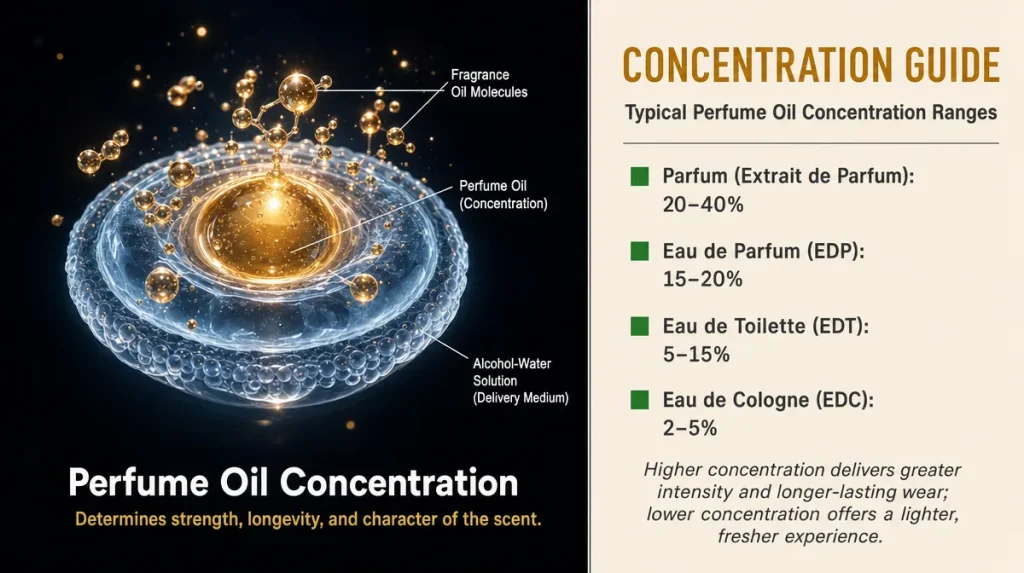
The terms on a perfume box (parfum, eau de parfum, eau de toilette, eau de cologne) describe one thing only: how much perfume oil is dissolved in the alcohol and water base. Eau de Parfum generally sits in the middle of that scale, more concentrated than eau de toilette, less than pure parfum.
Think of it like cordial. Parfum is closer to the undiluted syrup, eau de cologne is the same flavour stretched thin with water. Neither version is better made. A well-blended eau de toilette can smell more refined than a poorly balanced parfum.
What concentration actually buys you is time and depth. A higher oil percentage tends to unfold more slowly and sit closer to the skin for longer, so an Eau de Parfum often lasts several hours longer than a lighter version of the same scent. That is a genuine, measurable difference. Whether you like the smell is a separate question entirely, and no percentage on a box can answer it for you.
How Your Own Skin Writes The Final Scent
Two people can spray the identical bottle and walk away smelling noticeably different, and this is not imagination. Skin surface oil, pH, temperature and even recent diet all affect how quickly scent molecules evaporate and in what order.
A useful comparison is paint on different surfaces. Raw timber soaks up colour unevenly and the tone shifts as it dries. Primed, sealed wood holds the same paint closer to how it looked in the tin. Oilier skin behaves more like the raw timber: it holds onto base notes longer and can make a fragrance smell richer, sometimes muddier, over the day. Drier skin lets fragrance evaporate faster and can make the same scent read lighter and shorter-lived.
This is why a recommendation from a friend, however well meant, is only a starting point. A 2019 study in Flavour and Fragrance Journal found measurable differences in how identical fragrance compounds evaporated across participants with different skin surface lipid levels, confirming what perfumers have long worked around by hand. The only reliable test is your own skin, not someone else’s.
The Store-testing Method That Actually Works
Most fragrance disappointments trace back to how the testing happened, not what was tested. A paper strip held under your nose in a shopping centre tells you almost nothing about how a scent will behave on skin over a working day.
The better method takes longer, but it is simple. Spray one fragrance on the inside of your wrist or elbow, never rub it in (rubbing crushes the top notes and speeds up their breakdown). Then wait. The first fifteen minutes are the top notes, usually citrus, light florals or green accords, and they are the least representative part of the whole scent. The heart notes emerge over the next one to two hours and tend to reflect the fragrance’s real character. The base notes, often woods, musks or resins, settle in from around four hours onward and are what you will actually be wearing by evening.
Test no more than three fragrances in one visit. Beyond that, your nose fatigues and starts smelling everything as similar. A short self-test worth trying: spray your shortlist on separate days rather than side by side, and note down one word per fragrance at the four-hour mark. Buying decisions made from that small habit are far more reliable than anything decided in a shop within the first five minutes.
Longevity And Projection Are Two Different Promises
“Long-lasting” and “strong” are often used as if they mean the same thing, and they don’t. Longevity is how long you can still detect the scent on your own skin. Projection is how far it travels, how much other people notice without leaning in.
A fragrance can have excellent longevity and very quiet projection: still perceptible on your wrist at hour eight, but invisible to anyone more than arm’s length away. That is not a fault. It is a deliberate style choice in how a perfume is built, and it suits office settings well.
The common mistake is applying more product to compensate for a fragrance that feels too subtle, rather than accepting that subtlety was the design. Overapplication tends to flatten the scent’s structure, pushing all three note stages forward at once instead of letting them unfold. Two or three sprays to pulse points, rather than a cloud walked through, is enough for almost every Eau de Parfum on the market.
Reading An Ingredient List Without A Chemistry Degree
Fragrance ingredient lists are genuinely difficult to parse, partly because formulas are protected as trade secrets and often listed simply as “parfum” or “fragrance”, with only known allergens broken out separately.
One assumption worth retiring is that natural extracts are automatically gentler than synthetic aroma molecules. A 2021 study in the International Journal of Cosmetic Science found that several widely used synthetic fragrance compounds showed greater chemical stability and lower irritation potential in patch testing than a number of natural essential oil extracts, which can contain dozens of unlisted trace compounds. Synthetic is not a warning word. It is often the more consistent, better-tested option.
What is worth checking is the allergen declaration, a list of specific compounds (linalool, limonene, citronellol and similar) that must be disclosed above certain concentrations because a known minority of people react to them. If you have had skin reactions to fragrance before, that short list, not the marketing copy above it, is where to look.
Where Marketing Language Does The Selling
A perfume’s official “notes” (bergamot, jasmine, sandalwood, whatever the pyramid lists) describe an intended impression, not a literal recipe. Perfumers build these effects from dozens of raw materials, natural and synthetic, chosen to evoke bergamot or sandalwood rather than necessarily containing much of the raw plant at all. That’s not deception, it’s how the craft works, but it means the note list is closer to a tasting description than an ingredient audit.
Words like “clean”, “unisex” and “inspired by” carry no regulated meaning at all. “Clean” is a marketing category, not a safety standard. “Unisex” simply reflects a brand’s styling choice about who a scent is packaged for, not a chemical property. “Inspired by” is a legal phrase used to reference a well-known scent family without naming it directly.
None of this makes a fragrance worse. It just means the box is doing a selling job, and the only information on it worth weighing heavily is the concentration term and the allergen list. Everything else is storytelling, pleasant to read, not something to buy on faith.
Why That Half-used Bottle Turned
Perfume degrades. The citrus top notes fade first, the colour can deepen, and eventually the whole thing can smell flat or slightly sour compared with how it opened. This is oxidation, the same basic chemistry as a cut apple browning once it meets air.
Three things accelerate it: light, heat and repeated air exposure. UV light breaks down fragrant compounds and can visibly darken the liquid. Heat speeds every chemical reaction inside the bottle, which is why a fragrance left in a car or a steamy bathroom cabinet turns faster than one kept in a cool drawer. Every time a bottle is opened, a small amount of oxygen gets in, so bottles that are frequently opened and left uncapped for long periods degrade sooner than ones used briskly and closed straight away.
Storing a bottle in its original box, in a cool, dark cupboard away from the bathroom, can meaningfully extend how long it smells the way it did on the day you bought it. It won’t last forever regardless, most fragrances are best used within one to three years of opening, but the difference between careful and careless storage over that window is significant.
Building A Small Wardrobe Instead Of Chasing One Signature Scent
The idea of a single signature scent worn for decades is largely a marketing throwback. Skin chemistry shifts with the seasons, warmer months tend to intensify a fragrance’s projection, and heavier base notes that feel comforting in winter can read as heavy in January heat.
A more practical approach is a small rotation: something lighter and citrus or green-leaning for warm weather and daytime, something warmer with more amber, wood or musk for evenings and cooler months. Two or three well-chosen fragrances, worn according to season and occasion, tend to serve people better than one bottle asked to do every job.
A useful ongoing self-test is a simple scent journal. After wearing a fragrance for a full day, jot down one honest word at midday and one at evening. Patterns emerge quickly, some fragrances you love at the counter turn out to fade badly on you, others surprise you by improving after four hours. That record is worth more than any amount of browsing, because it is built entirely from your own skin’s response, which is the only data that actually applies to you.
Key Takeaways
Choosing an Eau de Parfum well comes down to separating what a label can genuinely tell you from what it is trying to sell you. Concentration terms describe strength and longevity, not quality or suitability. Your own skin chemistry, not the assistant’s wrist or a friend’s recommendation, determines the final result. Testing properly takes hours, not seconds, and storage habits can add real months to a bottle’s life. None of this requires expertise, only a slightly slower, more deliberate way of shopping.
A Five-minute Checklist Before You Buy
- Spray on skin, not paper, and never rub it in
- Wait at least two hours before judging the scent properly
- Limit any single testing visit to three fragrances
- Check the allergen list if you have reactive skin, not the marketing copy
- Ask whether you want longevity, projection, or both, before you decide it’s “too weak”
- Store bottles capped, boxed and away from bathroom heat and light
- Note one honest word about the scent at the four-hour mark before committing
This guide is general information and does not replace individual advice from a dermatologist or allergist.
Skin chemistry and personal preference vary, so results and reactions will differ from person to person.