
David Okonkwo, Senior Health and Science Editor.
There is a particular drawer in most bathrooms: six or seven eyeliner pencils, half of them sharpened down to a stub, one still in its cellophane because the colour looked different under shop lighting. Most of us bought each one hoping it would fix what the last one didn’t, usually smudging by mid-morning or a tip so soft it blunts before the second eye is done. The truth is less mysterious than the marketing suggests. Eyeliner performance comes down to three physical things: how the pigment sits on the lid, how the wax or gel base behaves against oil and moisture, and how the tip is shaped. A chemist at a contract cosmetics lab in Sydney once described a soft kohl pencil to us as ‘organised chalk dust held together by wax’, which is a fair description once you know it. Understand those three things and you can judge any pencil on a counter in under a minute, without reading a single marketing claim.
- Softness and staying power pull in opposite directions: a pencil soft enough to glide onto the waterline without tugging is, by chemistry, more prone to smudging than a firmer one.
- Swatch on the back of your hand, then check it an hour later: pigment that looks rich on the hand but smears when touched will do the same on your lid, and the shop test takes sixty seconds.
- Ingredient lists are shorter than the marketing copy makes them sound: most of what decides quality is three or four ingredients, and the rest is often fragrance, preservative and filler.
Why Your Eyeliner Fades By Lunchtime

Eyelid skin is thin and oily compared with most of the face, and the waterline sits in a permanently damp environment thanks to the tear film. A wax-based pencil applied to dry, oily or damp skin is fighting a losing battle from the start, in the same way chalk drawn on a footpath after rain never holds its line.
Most fading is not a pigment problem. It is a transfer problem. The wax base softens slightly from body heat and blinking friction, and pigment particles travel with it into the fine lines of the lid or down onto the lower lash line. A 2019 study in the International Journal of Cosmetic Science measured this transfer directly, finding that formulas with higher wax-to-oil ratios resisted migration for visibly longer under simulated blinking than softer, oil-rich formulas.
The fix starts before the pencil touches skin. Lids that are freshly moisturised or still carrying primer will always undercut staying power, regardless of the pencil’s price or pigment load. A thin layer of translucent powder pressed over bare lid skin, left to sit for a minute, gives the wax something drier to grip. This single step does more for longevity than most of what is printed on the packaging.
Wax, Gel Or Liquid In A Pencil: Telling The Formulas Apart
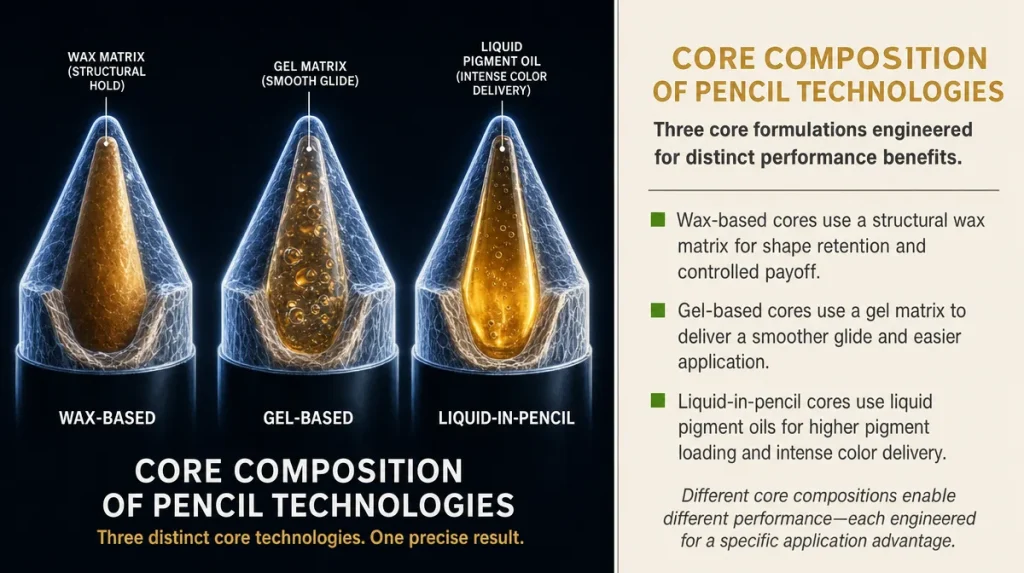
Not every eyeliner labelled ‘pencil’ contains the same thing inside the barrel. There are three broad bases, and they behave differently enough that knowing which you are holding changes how you should use it.
Traditional wax pencils, built from a blend of waxes like candelilla or carnauba with pigment and oil, are the softest and easiest to smudge deliberately for a smoky line. Gel pencils use a silicone or polymer base that sets firmer once applied, giving a sharper line that holds longer but can drag on delicate skin if the tip is not warmed first between the fingers for a few seconds. Liquid-in-pencil formats, newer to the market, push a liquid or mousse-like pigment through a felt or fine-point nib, aiming for the precision of a liquid liner with the ease of a pencil.
There is no universally ‘better’ base. A gel pencil chosen for an oily lid will usually outlast a wax one, but the same gel on a mature, drier lid can look patchy and cling to fine lines instead of sitting flat. Matching the base to your own lid condition, oily, dry or combination, matters more than any brand’s claims about longevity.
Testing Pigment Payoff Before You Buy
Counter lighting is designed to flatter, which makes colour judgement unreliable in store. There is a better test, and it takes under a minute.
Draw a short line on the inside of your wrist, where skin tone and oil level are closer to the eyelid than the back of the hand. Rub it gently with one finger after thirty seconds. A well-pigmented formula should still show clear colour, faintly softened but not gone. If it disappears entirely or turns to a smear of grey, the pigment load is too low to survive a full day near the eye.
Check opacity in a single stroke as well. Many pencils look fully black or brown only after two or three passes, which means more product sits on the lid than necessary and more chance of smudging. A pencil that reaches full colour in one careful stroke is doing more work per millimetre, which generally means a better pigment-to-wax ratio rather than a cheaper, bulked-out one.
Colour matching under shop lighting is worth double-checking near a window or doorway before paying, since fluorescent lighting shifts browns toward red and blacks toward flat grey.
The Tip Shape That Suits Your Hand
Tip shape decides how forgiving a pencil is for a shaky hand or a hurried morning, and this is rarely mentioned in reviews that focus only on colour.
A classic rounded tip, sharpened like a child’s colouring pencil, is softer to control and better for smoky, diffused lines along the lash line. A fine, chiselled tip, often found on retractable mechanical pencils, suits precise flicks and thin lines but requires a steadier hand, since there is less surface area to correct a wobble.
Retractable pencils never need sharpening, which sounds like a convenience but carries a trade-off: the mechanism limits how soft the core can be, since a very soft wax would crumble inside a twist-up barrel. Traditional wooden pencils can use softer, more pigmented cores precisely because sharpening removes the issue of a crumbling tip, at the cost of needing a sharpener on hand and losing a little product with each sharpen.
If your hand is unsteady or you are applying liner on a moving train or in a car park before work, a rounded, slightly softer tip will forgive more than a fine chiselled one, even if the chiselled tip gives a cleaner line on a calm morning at home.
Lining The Waterline Without It Migrating
The waterline is the single hardest place on the face to keep makeup in place, because it sits directly in the path of the tear film and every blink physically wipes it.
The main mistake is applying a standard wax pencil meant for the lash line onto the waterline and expecting the same performance. Waterline-safe formulas are typically firmer and more water-resistant, designed to shed moisture rather than absorb it, whereas a softer lash-line pencil will often turn patchy and migrate into tiny dots along the lower lashes within an hour.
A second common mistake is applying too much in one pass. The waterline has almost no surface to hold product, so a thick application simply has nowhere to sit and transfers onto the lower lid instead. A thin, single pass, reapplied later if needed, consistently outperforms one heavy application.
The Australasian College of Dermatologists’ general public guidance on eye-area cosmetics notes that the waterline and inner rim carry a higher risk of irritation and infection than the outer lash line, since product sits closer to the tear duct. Its advice to replace eye pencils more often than other cosmetics and avoid sharing them is sound practical guidance worth following regardless of formula or price.
Reading An Ingredients List Without Being Fooled By The Marketing
Packaging copy often lists what a pencil is infused with before the ingredients panel on the back states what it actually contains in meaningful quantity. These are not always the same thing.
The ingredients that genuinely decide performance are usually near the top of the list: the wax or gelling agent, the pigment type, often iron oxides for browns and blacks, and an emollient oil that keeps the pencil from feeling scratchy. Everything below the midpoint of a typical ingredients list, vitamin E, botanical extracts, antioxidant complexes, is usually present in amounts too small to meaningfully change how the product performs on skin, even where the front of the box makes it the headline feature.
A practical habit: find where preservatives appear on the list. If a ‘natural’ or ‘clean’ claim sits above a standard preservative system in roughly the same position it would on any other pencil, the formula is likely conventional with different marketing rather than meaningfully different chemistry. This is not a criticism of the product, simply a useful way to separate what you are paying for the base formula versus what you are paying for the story on the box.
How Long A Pencil Should Last, And When It Has Gone Off
Most wax-based pencils have a shelf life of around twelve to eighteen months once opened, noted by the small open-jar symbol on the packaging with a number inside, typically ’12M’ or ’18M’. Daily sharpening slows degradation somewhat, since it removes the outer layer that has been exposed to air and repeated contact with the eye area.
Signs a pencil has passed its useful life are usually obvious once you know to look: a change in texture from smooth to gritty or waxy-hard, a faint change in smell, or pigment that no longer applies evenly despite sharpening. Any of these is reason enough to replace it, since a pencil in this state is both less effective and more likely to irritate the eye area.
Hygiene matters more for eye pencils than for most other cosmetics, given their proximity to the tear duct. Sharpening regularly removes contaminated surface material, and a pencil that has not been sharpened in months should be treated with more caution than one in regular use. CHOICE, the Australian consumer organisation that has lab-tested household and personal care products since 1959, has published general guidance on cosmetic shelf life noting that eye-area products carry higher hygiene stakes than lip or cheek products, which lines up with most dermatological advice on the subject.
Matching Formula To Sensitive Eyes And Contact Lenses
Contact lens wearers face a specific problem: tiny pigment particles that flake off a dry, crumbly pencil can migrate under a soft lens and cause irritation that has nothing to do with the lens itself.
Formulas described as ophthalmologist-tested or suitable for sensitive eyes are generally lower in fragrance and built with finer-milled pigment particles, which reduces flaking. This is one of the few marketing claims worth taking seriously, since it usually reflects a genuine formulation choice rather than a cosmetic one.
A simple self-test for sensitivity: apply the pencil to the inner wrist and leave it for a few hours before trying it near the eye for the first time. Mild redness, itching or a grainy feeling afterward suggests either the fragrance load or the pigment particle size is unsuitable for a sensitive eye area, even if the product performs well elsewhere.
Anyone with a history of eye irritation, allergy or lens discomfort should patch test a new formula this way before applying it to the lash line, and should discontinue use if irritation develops, seeking advice from a GP or optometrist if symptoms persist beyond a day or two.
Key Takeaways
Staying power and softness work against each other, so choose based on which matters more for your day. Pigment should hold up to a rub test on the wrist, not just look good under shop lighting. Tip shape changes how forgiving a pencil is far more than most reviews suggest. The waterline needs a different formula and a thinner application than the lash line. Most of what decides quality sits in the first few ingredients on the list, not the claims on the front of the box. Replace eye pencils more often than other cosmetics, and sharpen regularly if the format allows it.
A Checklist For The Counter
- Swatch on the inner wrist and check colour after thirty seconds, not immediately
- Note whether the tip is rounded (softer, more forgiving) or chiselled (precise, needs a steady hand)
- Check the open-jar shelf-life symbol before buying, not after
- Ask whether the formula is described as suitable for the waterline, or only the lash line
- Scan the ingredients list for where preservatives sit relative to any ‘natural’ claims
- Patch test on the wrist first if you wear contact lenses or have sensitive eyes
This article is general information only and does not replace advice from a dermatologist, optometrist or GP.
Individual skin and eye sensitivity varies, and results from any product or method described may vary between readers.