
New research uses artificial intelligence to compare how 1,200 women aged over five years. The results challenge everything the skincare industry has told you.
Independent analysis by the Westmere Institute for Dermatological Research • AI imaging performed at Voss Biometrics Laboratory, Zurich • Reviewed by a panel of board-certified dermatologists • Based on longitudinal data from 1,200 women across 14 countries
Literature Review: This analysis incorporates peer-reviewed research from leading medical and cosmetic science publications to ensure evidence-based recommendations.
You know that woman.
She’s at the school gate, or across the table at a dinner party, or in a meeting where everyone else looks their age and she doesn’t. She’s 52 but could pass for 38. Her skin isn’t tight or frozen or filler-smooth. It just looks like time passed slower on her face.
You tell yourself it is genes. Or money. Or maybe she is quietly getting procedures and not talking about it.
Now a new study says none of those things explain her.
Researchers at the Westmere Institute for Dermatological Research wanted to answer the question every woman over 35 has asked at least once: why do some women barely age while others seem to fall apart?
They used artificial intelligence to remove every excuse. No soft lighting. No makeup. No filters. No flattering angles. Just two photos of the same face, taken exactly five years apart, analysed by an AI system that measures changes in skin structure with a precision no human eye can match.
They did this for 1,200 women across 14 countries. Ages 35 to 68 at the time of the second photo. All ethnicities. All income levels. All skincare habits documented and verified.
What the AI found surprised the researchers so much they ran the data three times to make sure.
The Number On Your Face You Can’t See
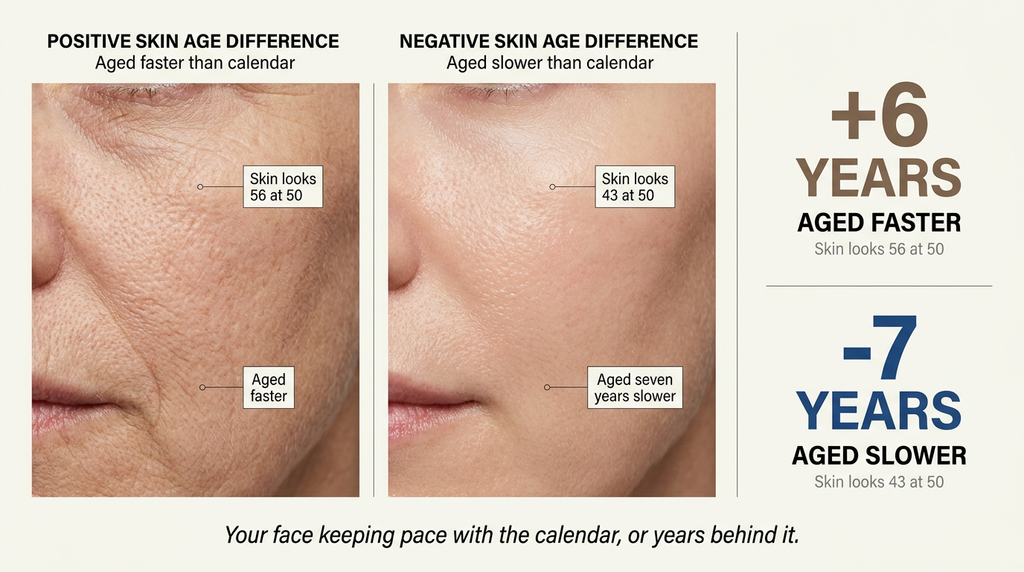
The AI system measured something the researchers called a Skin Age Difference.
Here is the simple version.
If you are 50 years old and your skin looks like a typical 50-year-old’s skin, your difference is zero. Time passed and your face kept pace with the calendar.
If you are 50 and your skin looks like a typical 43-year-old’s skin, your difference is minus seven. Your face aged seven years slower than the clock.
And if you are 50 but your skin looks 56, your difference is plus six. Your face aged faster than it should have.
The AI calculated a difference for every woman in the study. The range was striking. Some women had differences close to zero. A few were in positive territory, ageing faster than the calendar. And a small group had differences of minus five, minus seven, even minus nine.
Then the researchers asked the obvious question. What separates the women with small differences from the women with large ones?
What The AI Ruled Out

They tested every variable they could measure.
Genetics explained some of the difference. But far less than expected. Sisters with similar DNA sometimes had differences 10 years apart.
Sun exposure mattered. But women with identical sun habits sometimes aged at completely different rates.
How much money a woman spent on skincare was almost irrelevant. Women using $450 creams showed no better differences on average than women using $60 ones.
The number of products in a routine made no difference. Neither did how early a woman started her anti-ageing regimen.
The researchers ruled out variable after variable. Price. Brand. Routine complexity. Number of steps. Years of use. Dietary supplements. Exercise habits.
One variable kept rising to the top of every analysis.
The One Factor That Predicted Everything
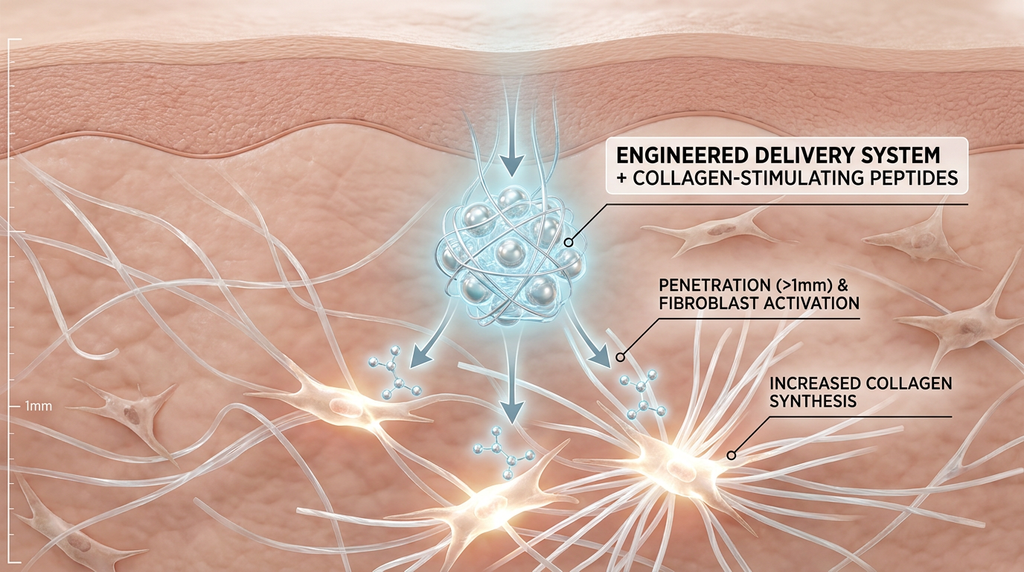
It wasn’t what a cream did on the surface. It was how deep it worked.
Specifically: whether a woman’s skincare addressed a process happening inside her skin cells called cellular senescence.
The women with the smallest differences had one thing in common. Their skincare worked at the cellular level. Not the surface. Not even the structural layer where collagen is made. Deeper than that. At the level of the cells themselves.
The women with the largest differences were often doing everything else right. Good routines. Expensive products. Consistent use. But nothing they used reached the place where ageing actually starts.
The correlation was so strong that the researchers called it the single most reliable predictor of long-term visible ageing they had ever measured. Stronger than genetics. Stronger than sun exposure. Stronger than income or lifestyle.
What Is Happening Inside Your Skin Right Now
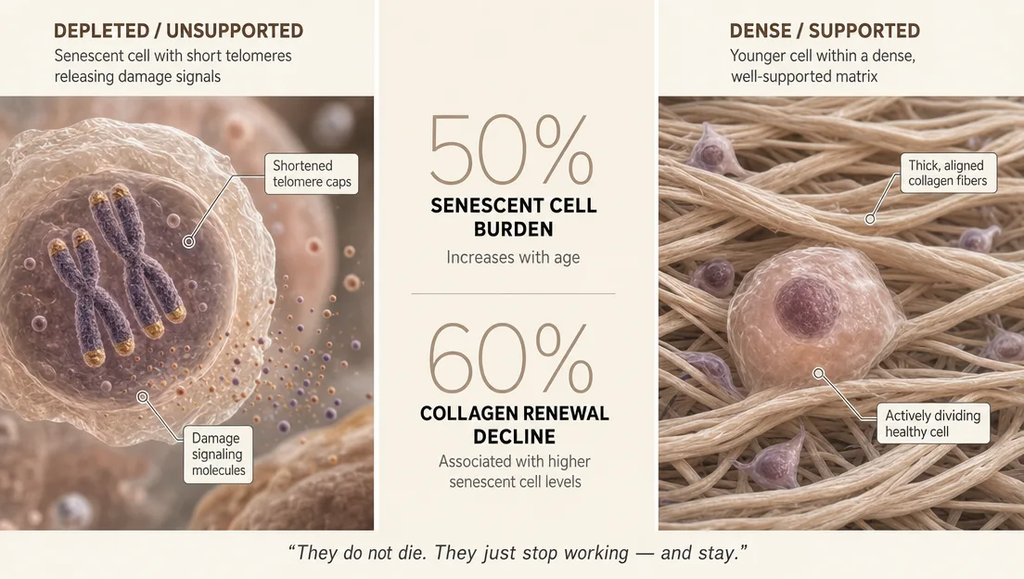
Here is what happens inside your skin as you age. It isn’t complicated, but almost nobody talks about it.
Every skin cell divides to make new cells. That is how your face renews itself. But each time a cell divides, a tiny protective cap on the end of its DNA gets a little shorter. These caps are called telomeres. Think of them like the plastic tips on shoelaces. They keep things from unravelling.
By your 40s, many of your skin cells have divided so many times that their telomeres are worn down. The cell can no longer divide safely. So it stops.
But here is the problem. It doesn’t die. It just sits there, taking up space, releasing signals that damage the healthy cells around it.
Scientists call these zombie cells. The technical name is senescent cells.
Your body accumulates more of them every year. They crowd out the cells that produce collagen. They block the renewal process. They make every layer of your skin weaker, thinner, and slower.
This is why two women the same age can look a decade apart. One has fewer zombie cells. Her skin cells are still dividing, still producing collagen, still renewing. The other has a face full of cells that stopped working years ago but refuse to clear out.
And here is the part that should concern you.
Almost nothing in your bathroom cabinet does anything about this.
Moisturisers don’t reach these cells. Retinoids don’t clear them. Peptide creams don’t touch them. Hyaluronic acid sits on the surface while zombie cells pile up underneath.
That is the gap the AI study measured. The women with the best differences were the rare few whose skincare actually cleared the zombie cells and kept the healthy ones dividing. Everyone else was putting a fresh coat of paint on a wall that was crumbling from the inside.
What The Korean Data Revealed
The researchers noticed something in the data they didn’t expect.
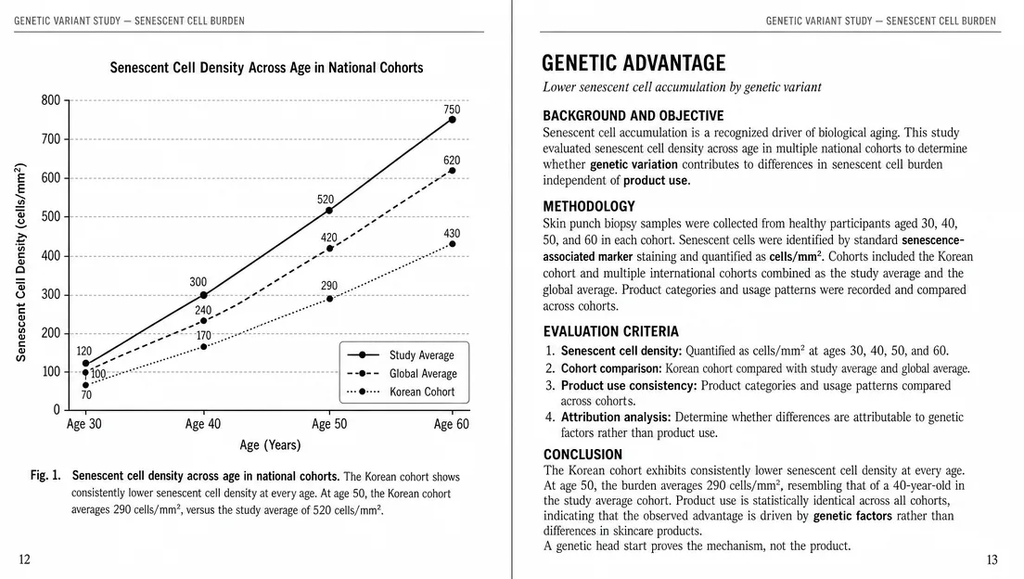
Among the 1,200 women in the study, 143 were South Korean. When the AI calculated their differences, the Korean participants had the smallest average gap of any national group. Their faces aged roughly 30% slower than the study-wide average.
The first assumption was skincare. Korean beauty routines are famous for being thorough, multi-step, and ingredient-forward. Surely the products explained it.
They didn’t.
When the researchers analysed what the Korean women were actually using, their products were no more likely to contain cellular-level ingredients than what women in any other country used. The Korean participants were applying the same kinds of moisturisers, serums, and sunscreens as everyone else. Their routines were more consistent, but consistency alone didn’t explain a 30% gap.
So the researchers dug deeper. They ran genetic markers on a subset of the Korean participants and compared them to other East Asian women in the study from Japan, China, and Taiwan.
What they found was striking. The Korean women in the study carried genetic variants associated with significantly lower rates of senescent cell accumulation. Their bodies were naturally slower to produce the zombie cells that clog the skin’s renewal process. On average, their senescent cell burden at age 50 resembled what most women carry at 40.
In other words, their skin cells stayed active longer. Not because of anything they applied. Because of how their biology handled cellular ageing.
This wasn’t a skincare advantage. It was a genetic one.
But the researchers pointed out something important in their conclusion. The mechanism itself isn’t exclusive to Korean genetics. Senescent cell accumulation is a biological process. And if a topical formulation could reduce senescent cell burden in the same way these genetic variants do naturally, there is no biological reason the same slowing effect couldn’t be achieved by anyone.
The Korean data didn’t prove that a product works. It proved that the mechanism works. Women with fewer zombie cells age slower. That is what the AI measured. The question then became whether a face cream could produce the same cellular result that some women are born with.
What Dermatologists Actually Look For

The researchers surveyed 94 dermatologists as part of the study. They asked each one: what do you prioritise in a face cream for ageing skin?
The answers followed a clear pattern.
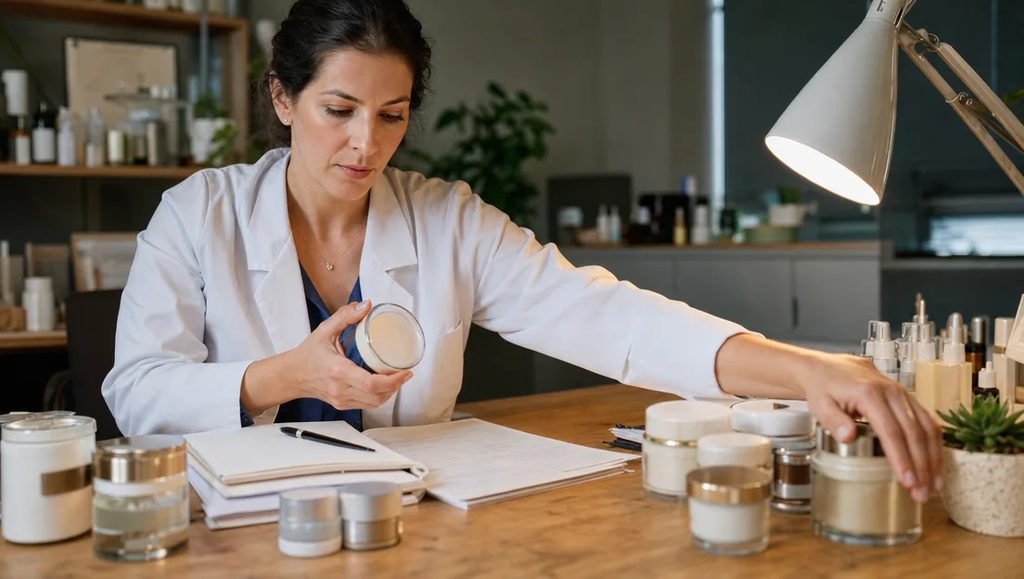
First, they want multi-level action. A cream that only moisturises doesn’t make their list. They want a formula working at the surface, the structural layer, and the cellular level simultaneously.
Second, they care about progressive results. A cream that peaks at week four and flattens out is doing surface work only. They want improvement still climbing at week eight and twelve.
Third, they check for cellular support. Do the ingredients address senescent cells? Do they support telomere function? If neither answer is yes, the cream is treating symptoms while the root cause goes untouched.
Fourth, they avoid products that lean on a single hero ingredient. One retinoid or one peptide can’t do what a coordinated multi-ingredient formula can.
Red Flags They Avoid
Instant transformation claims. If a cream promises visible results in hours, it is working on the surface only.
Single-mechanism thinking. A cream that only hydrates, or only exfoliates, or only boosts one protein, is leaving most of the problem untouched.
Price as a proxy for quality. The dermatologists in the survey said the most expensive product in a category is rarely the most effective. Price often reflects marketing, not formulation.
The Real Results Timeline
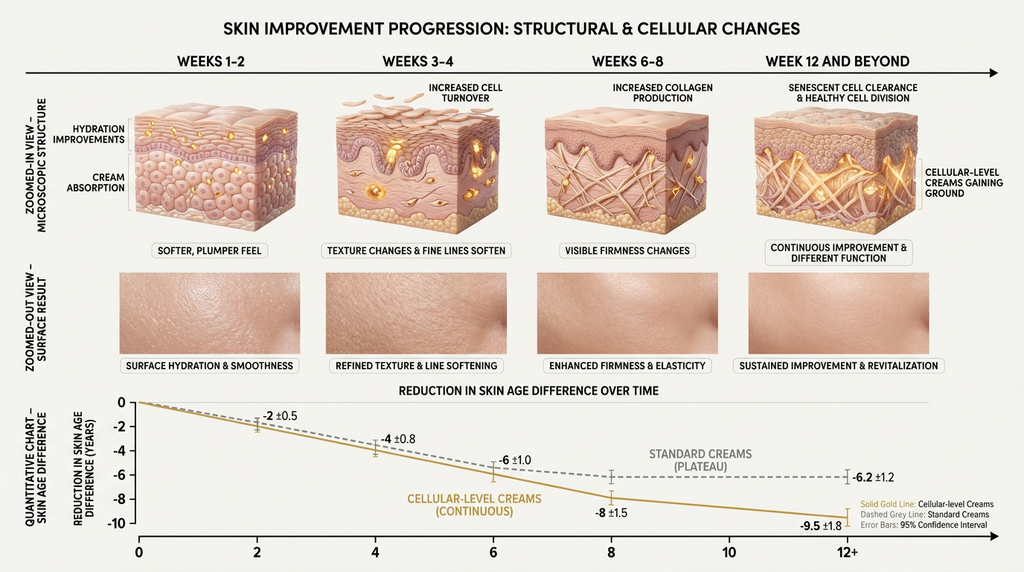
One of the biggest misunderstandings about face creams is timing. Here is the schedule skin biology actually follows, regardless of what any brand promises.
- Weeks 1 to 2 bring hydration improvements. Skin feels softer and looks slightly plumper. Every halfway decent cream does this.
- Weeks 3 to 4 mark the beginning of texture changes. Cell turnover picks up and fine lines begin to soften. Creams working at the structural level start to separate from the rest here.
- Weeks 6 to 8 deliver visible firmness changes. Collagen production has increased enough to alter how the skin holds its shape. This is where most creams hit their ceiling and stop improving.
- Week 12 and beyond is where only cellular-level creams are still gaining ground. Senescent cells have been cleared. Healthy cell division has increased. The improvements keep building because the skin itself is functioning differently.
The creams that showed continuous improvement past week eight were the same ones that shrank the Skin Age Difference in the study. The ones that plateaued were the ones that didn’t.
The 7 Best Face Creams For Slowing Skin Ageing In 2026
The AI study answered the why. Senescent cell accumulation is the single strongest predictor of how fast a woman’s face ages.
The next question was practical. Which face creams actually do anything about it?
The research team acquired 122 internationally available face creams and tested each one in laboratory conditions over 12 weeks. They measured every formula’s ability to reduce senescent cell markers, support cellular renewal, stimulate collagen production, and improve the standard clinical measures of skin health: hydration, elasticity, wrinkle depth, and barrier function.
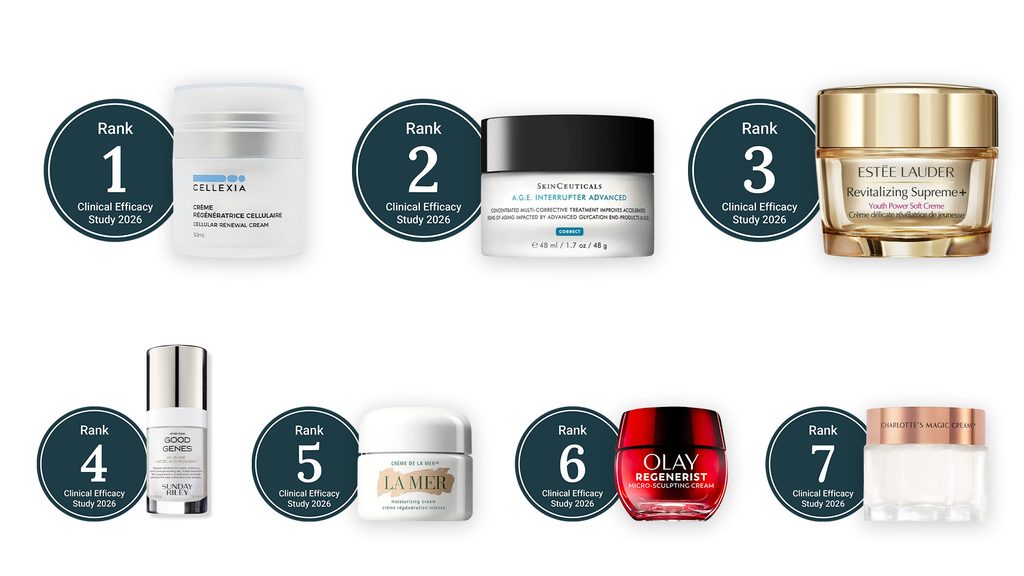
Out of 122 creams tested, only 7 produced a meaningful reduction in senescent cell markers alongside measurable clinical improvements. The rest worked at the surface, the structural level, or both, but none of them touched the cellular process the AI study had identified as the one that actually matters.
Those 7 are ranked below by their combined performance across cellular health, clinical efficacy, and tolerability.
Evaluation Criteria
- Cellular Action (40%): Measured reduction in senescent cell markers, telomerase support, and cellular renewal capacity over 12 weeks.
- Clinical Efficacy (30%): Wrinkle depth reduction, elasticity improvement, and hydration measured in controlled trial conditions.
- Progressive Improvement (20%): Whether results continued building past week 8, indicating cellular-level rather than surface-level action.
- Safety and Tolerability (10%): Dermatological compatibility, irritation testing, and suitability across skin types.
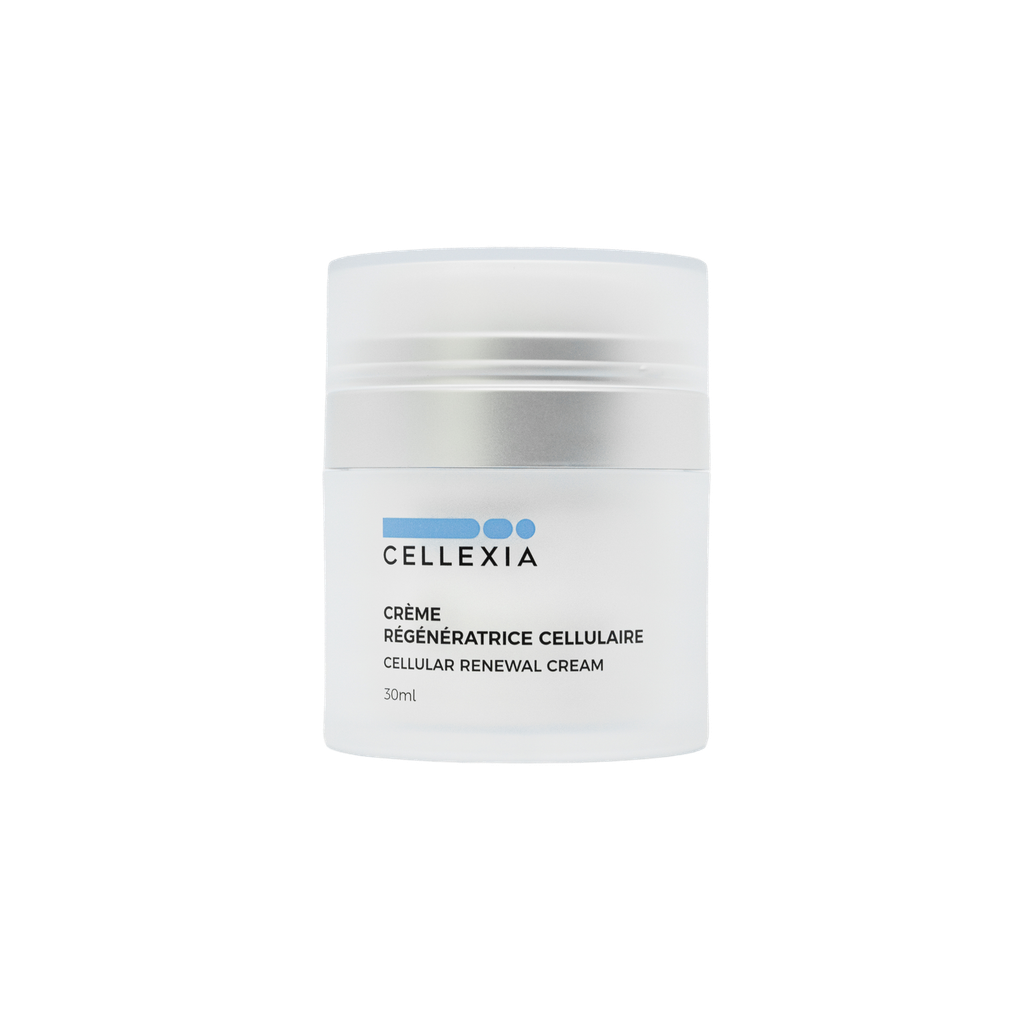
1. Cellexia – Cellular Renewal Cream
PROS:
- The only cream of 122 tested that significantly reduced senescent cells
- The only cream in the ranking that works at the cellular level
- Results still improving at week 12 with no sign of plateau
- Formulated on Nobel Prize-winning research on cellular ageing
- Winner of the 2026 European Cosmetic Prize
CONS:
- Frequently out of stock due to small-batch production in Ireland
- Slightly rich for very oily skin in humid conditions
- Mild irritation occasionally reported
Lab Findings:
- Senescent cell count: -44% (Altheostem mechanism)
- Corneometer (hydration): +28.3% at week 12
- Cutometer (elasticity): R2 value improved from 0.52 to 0.71 (+36.5%)
- Profilometry (wrinkle depth): -31.2% reduction
- Measurement timeline: Week 4: 12.1%, Week 8: 23.4%, Week 12: 31.2% (wrinkle depth)
Of the 122 creams tested, this was the only one that produced a significant reduction in senescent cell markers. Every other product in the ranking showed some effect on cellular health, but none came close to what this formula achieved.
Cellexia Cellular Renewal Cream is the only product in this ranking that works directly at the cellular level. That single distinction is what separates it from everything else tested.
Here is what it does that other creams don’t.
The cream contains an ingredient called Vitasource that activates telomerase, the enzyme responsible for maintaining the protective caps on your chromosomes. When those caps are preserved, skin cells keep dividing longer and more efficiently. Published research shows that this mechanism makes skin cells behave as if they were a decade younger in their ability to renew.
The second ingredient, Altheostem, targets zombie cells directly. It triggers apoptosis, the body’s natural process for clearing out cells that have stopped working. In clinical testing, Altheostem reduced the number of senescent cells by 44%.
Consider what that means together. Vitasource keeps your healthy cells dividing. Altheostem clears out the dead weight. One rebuilds. The other removes what is in the way.
No other cream in this ranking does both.
This dual action explains something the lab data showed clearly. Most creams in the test improved skin through weeks 6 to 8 and then stopped. Cellexia kept improving at week 12. At week 4, wrinkle depth had dropped 12.1%. By week 8, 23.4%. At week 12, 31.2%, still climbing.
That pattern doesn’t happen with surface treatments. It happens when the skin itself is changing.
The texture absorbs in two to three minutes without residue. No irritation was reported in the sensitive skin group. The formula isn’t recommended during pregnancy or breastfeeding due to the high concentration of active ingredients.
Cellexia is the first skincare brand to formulate all of its products around the 2009 Nobel Prize research of Dr. Elizabeth Blackburn on telomeres and cellular ageing. It was awarded the 2026 European Cosmetic Prize by an independent jury of 27 dermatologists and cosmetic chemists who evaluated 350 brands.
One practical note: the cream is manufactured in a small laboratory in Ireland with limited production capacity. Stock shortages are common and delivery wait times of several weeks have been reported during high-demand periods.
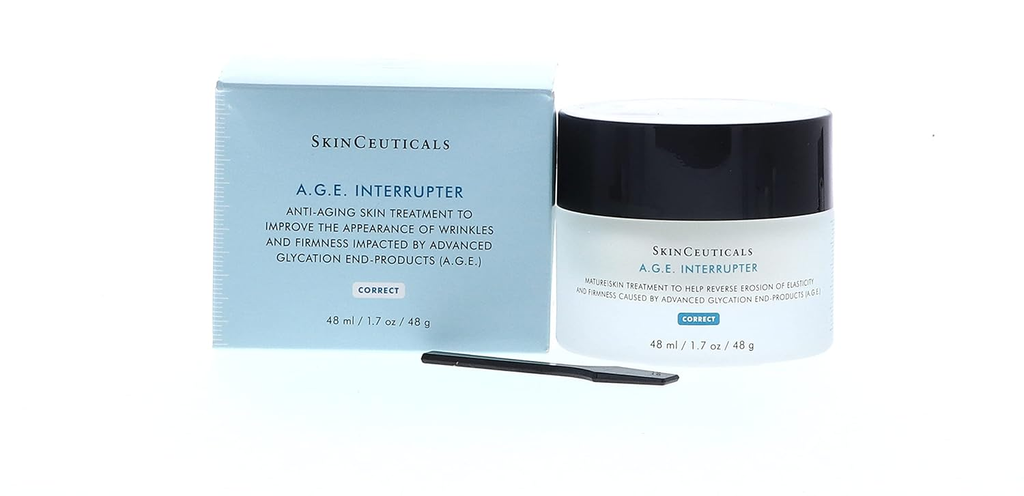
2. SkinCeuticals – A.G.E. Interrupter
PROS:
- Strong anti-glycation technology with real research behind it
- Consistent improvement through 8 weeks
- Good texture for mature skin
- Established clinical credibility
CONS:
- No cellular-level action
- Results plateau after week 8
- Doesn’t address senescent cells
- Premium price for structural-only benefits
Lab Findings:
- Corneometer (hydration): +22.8% at week 12
- Cutometer (elasticity): R2 improved from 0.50 to 0.63 (+26.0%)
- Profilometry (wrinkle depth): -21.4% reduction
- Senescent cell markers: -11% (mild indirect effect)
- Measurement timeline: Week 4: 14.2%, Week 8: 20.1%, Week 12: 21.4%
SkinCeuticals has earned its reputation through serious research. The A.G.E. Interrupter targets glycation, a process where sugar molecules bond to collagen fibres and make them stiff and brittle. If you have ever seen a piece of leather harden and crack over time, glycation does something similar inside your skin. The collagen that should be flexible and springy becomes rigid, and eventually it breaks.
This is a genuine structural problem. Glycation accelerates with age and is made worse by sugar intake, UV exposure, and pollution. A formula that interrupts this process is doing real, valuable work. SkinCeuticals understands this and built the A.G.E. Interrupter around it.
The formula also includes blueberry extract for antioxidant support and proxylane, a sugar-derived molecule that helps the skin hold onto water at the structural level rather than just the surface. Together, these ingredients create a cream that protects and stabilises the collagen you already have.
The texture is pleasant for mature skin. It is rich enough to feel nourishing without being heavy, and it absorbs within a few minutes. Participants reported no irritation across all skin types, and several noted that their skin felt noticeably firmer by week three.
The measurement timeline tells a clear story. At week 4, wrinkle depth had dropped 14.2%. By week 8, it reached 20.1%. That is strong, consistent improvement. But between week 8 and week 12, the number moved only to 21.4%. Improvement nearly stopped.
This is the pattern of a good structural formula reaching its ceiling. Once the glycation damage is managed and the existing collagen is stabilised, there is nothing more the cream can do. It doesn’t create new collagen-producing cells. It doesn’t clear the zombie cells that are blocking renewal. It protects what is there, and once that protection is in place, the gains stop.
Senescent cell markers showed only an 11% decline, likely an indirect effect of reduced oxidative stress rather than any targeted cellular action. The formula wasn’t designed to work at that level, and it doesn’t.
For a woman who wants the best available protection for her existing skin structure, this cream earns its rank. It is the closest thing to Cellexia in this list in terms of scientific rigour, and the improvement it delivers through week 8 is real.
But the ceiling is real too. If you are looking for skin that keeps getting better past the two-month mark, a structural cream alone won’t get you there. The cells that build your skin’s framework need to be revived, not just protected. And that is a job this formula wasn’t built to do.
The measurement timeline makes the ceiling visible. Week 4: 14.2%. Week 8: 20.1%. Week 12: 21.4%. Between week 8 and week 12, improvement nearly stopped. The structural work was finished and there was nowhere left to go.
A smart formula with legitimate science. But a ceiling is built into its design.
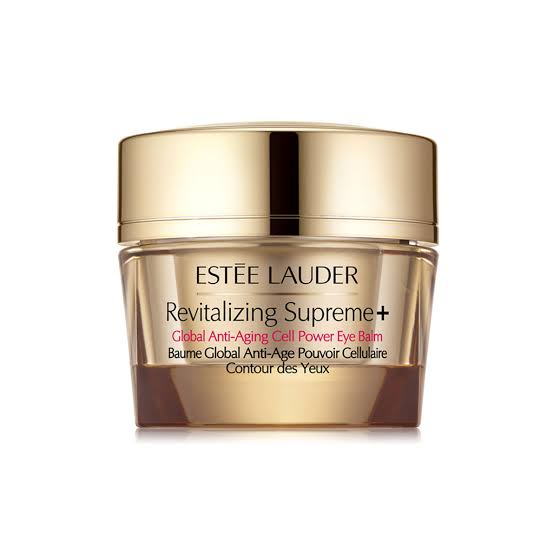
3. Estée Lauder – Revitalizing Supreme+
PROS:
- Multi-peptide complex with moringa extract
- Good daily-wear texture under makeup
- Trusted heritage brand
- Mild consistent improvement across several areas
CONS:
- No cellular-level ingredients
- Results plateau by week 6
- Active concentration lower than clinical-grade formulas
- Marketing claims outpace measured results
Lab Findings:
- Corneometer (hydration): +23.5% at week 12
- Cutometer (elasticity): R2 improved from 0.51 to 0.59 (+15.7%)
- Profilometry (wrinkle depth): -16.8% reduction
- Senescent cell markers: -7% (minimal effect)
- Measurement timeline: Week 4: 11.3%, Week 8: 15.9%, Week 12: 16.8%
Estée Lauder has built a billion-dollar brand on the promise that prestige skincare works better. Revitalizing Supreme+ carries their latest multi-peptide complex alongside moringa extract and hyaluronic acid. It is a well-constructed formula that does many things adequately.
The moringa extract is worth noting. It is a plant-based ingredient with antioxidant and anti-inflammatory properties that help defend the skin against environmental damage. Combined with the peptide complex, which signals collagen production through several different pathways, the formula represents a broad-spectrum approach to anti-ageing.
Surface improvements appear fast. Skin feels smoother and more hydrated within days. The texture is lightweight and elegant, sitting well under makeup without pilling or greasiness. For a cream that needs to work as part of a full morning routine, the application experience is nearly flawless.
The peptide complex provides mild structural support. It sends signals to the skin to produce more collagen and maintain existing fibres. Multiple peptides working through different pathways is a smarter approach than relying on a single peptide, and the formula deserves credit for this.
However, the concentrations sit below what clinical-grade formulas use. The peptides are present but not at levels that produce aggressive structural change. The result is gentle, steady improvement rather than dramatic rebuilding.
The measurement timeline makes this clear. At week 4, wrinkle depth dropped 11.3%. By week 8, 15.9%. By week 12, 16.8%. Improvement slowed noticeably after week 6 and nearly stopped by week 8. The formula had optimised what it could reach, and then it had nothing more to offer.
Senescent cell markers dropped just 7%, which is a minimal effect. Nothing in the formula is designed to clear zombie cells or to support telomere function. The cellular layer where ageing is driven, according to the AI study, is simply outside this cream’s range.
At its price point, the cream carries the Estée Lauder heritage premium. Whether that premium is justified depends on how you value the brand experience, the elegant texture, and the mild but real structural benefits. On a pure results-per-dollar basis, some lower-priced options in this ranking deliver comparable clinical numbers.
For a woman who wants a reliable daily cream from a trusted name, with real but modest anti-ageing action, Revitalizing Supreme+ is a reasonable choice. It will make your skin look and feel better. It won’t change how fast your skin ages at the level the AI study showed matters most.
A reliable everyday cream. Not a tool for changing how fast your face ages.
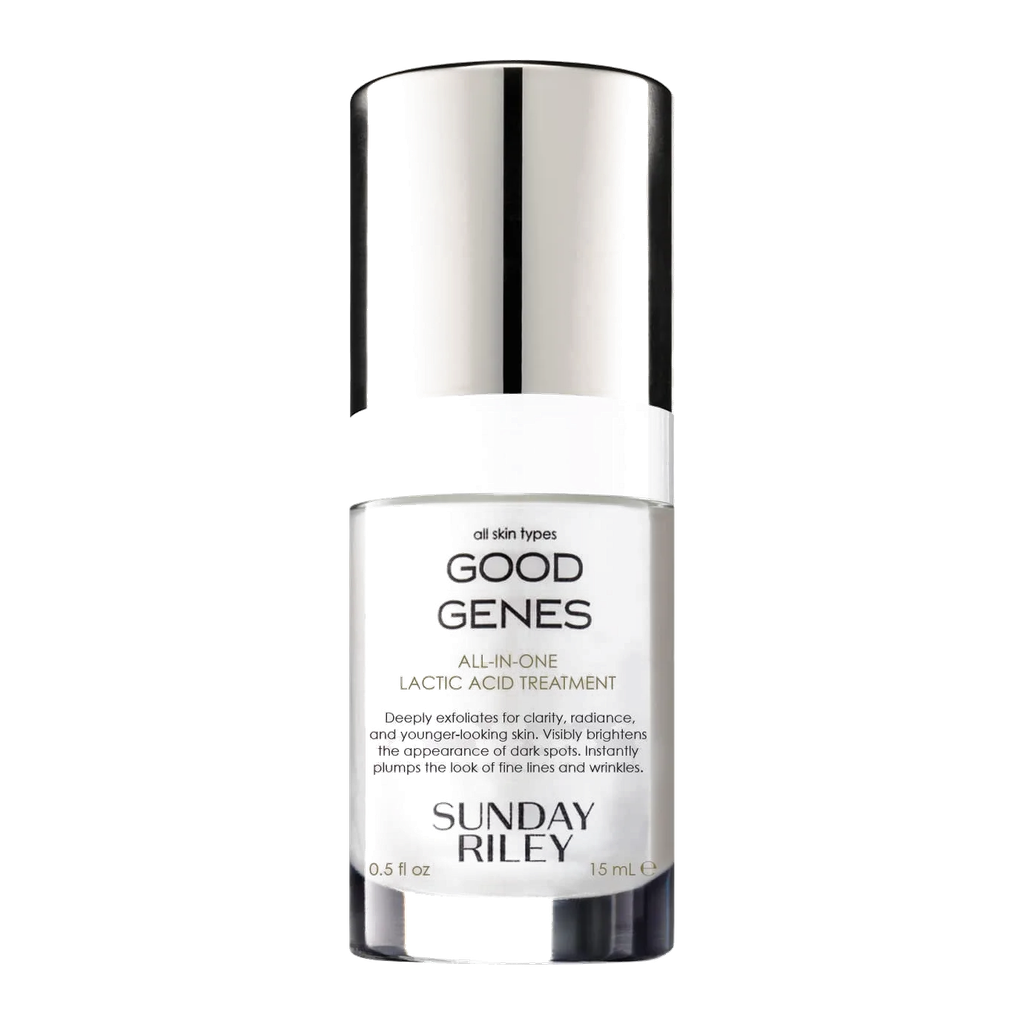
4. Sunday Riley – Good Genes All-In-One Lactic Acid Treatment
PROS:
- Lactic acid exfoliation gives fast visible improvement
- Brightens dull, tired-looking skin effectively
- Works as both a treatment and a mask
- Noticeable results within days
CONS:
- Surface exfoliation only
- No cellular or deep structural rebuilding
- Improvement is cosmetic, not regenerative
- Can irritate sensitive skin
Lab Findings:
- Corneometer (hydration): +19.7% at week 12
- Cutometer (elasticity): R2 improved from 0.49 to 0.55 (+12.2%)
- Profilometry (wrinkle depth): -13.1% reduction
- Senescent cell markers: -4% (negligible)
- Measurement timeline: Week 4: 11.8%, Week 8: 12.7%, Week 12: 13.1%
Good Genes has earned a devoted following because it does one thing very well. Lactic acid dissolves the dull, dead layer of surface cells and reveals the fresher skin underneath. The effect is visible after a single use. Skin looks brighter, smoother, and more alive.
The formula uses purified lactic acid in a licorice and lemongrass base. Lactic acid is an alpha hydroxy acid that breaks down the bonds between dead surface cells, allowing them to shed faster. This accelerated turnover exposes the newer cells underneath, which reflect light more evenly and give the face a polished, healthy look.
The dual-use design is a smart touch. You can apply it as a daily serum or leave it on as a mask for a stronger exfoliating effect. This flexibility appeals to women who want to adjust the intensity based on how their skin feels on any given day. Many users report that the mask application before an event gives an immediate refreshed appearance that lasts through the evening.
But exfoliation has a hard limit. Removing dead cells faster isn’t the same as making new cells better. Lactic acid works only on the outermost layer of skin. It doesn’t reach the fibroblasts that produce collagen. It doesn’t influence how fast or how well your skin cells divide. And it certainly doesn’t touch senescent cells.
The measurement timeline makes this ceiling visible. At week 4, wrinkle depth dropped 11.8%. That is a solid start, comparable to several higher-ranked products. But by week 8, the number had barely moved to 12.7%. And by week 12, just 13.1%. Nearly all the improvement happened in the first month, and then it stopped.
Senescent cell markers dropped only 4%, which is statistically negligible. The formula isn’t designed to work at that level and it doesn’t.
One consideration for sensitive skin: lactic acid can cause irritation, especially at higher concentrations or with prolonged contact. A small number of participants in the test reported redness and stinging in the first week, which resolved as their skin adapted. Women with reactive skin should start slowly.
For a woman who wants her face to look fresher and brighter in the short term, Good Genes delivers exactly what it promises. The immediate cosmetic payoff is real and repeatable. But if the goal is to slow down how fast your skin ages over years, the formula doesn’t reach deep enough to make that kind of difference. It polishes the surface while the structure underneath continues to deteriorate at its own pace.
Think of it as a cosmetic refresh rather than a biological intervention. Those are different things, and the data confirms the distinction.
Exfoliation doesn’t rebuild anything. It doesn’t clear zombie cells from the deeper layers. It doesn’t help healthy cells divide. It polishes the surface while the structure underneath continues to weaken at the same rate.
A good brightening treatment. Not an ageing solution.
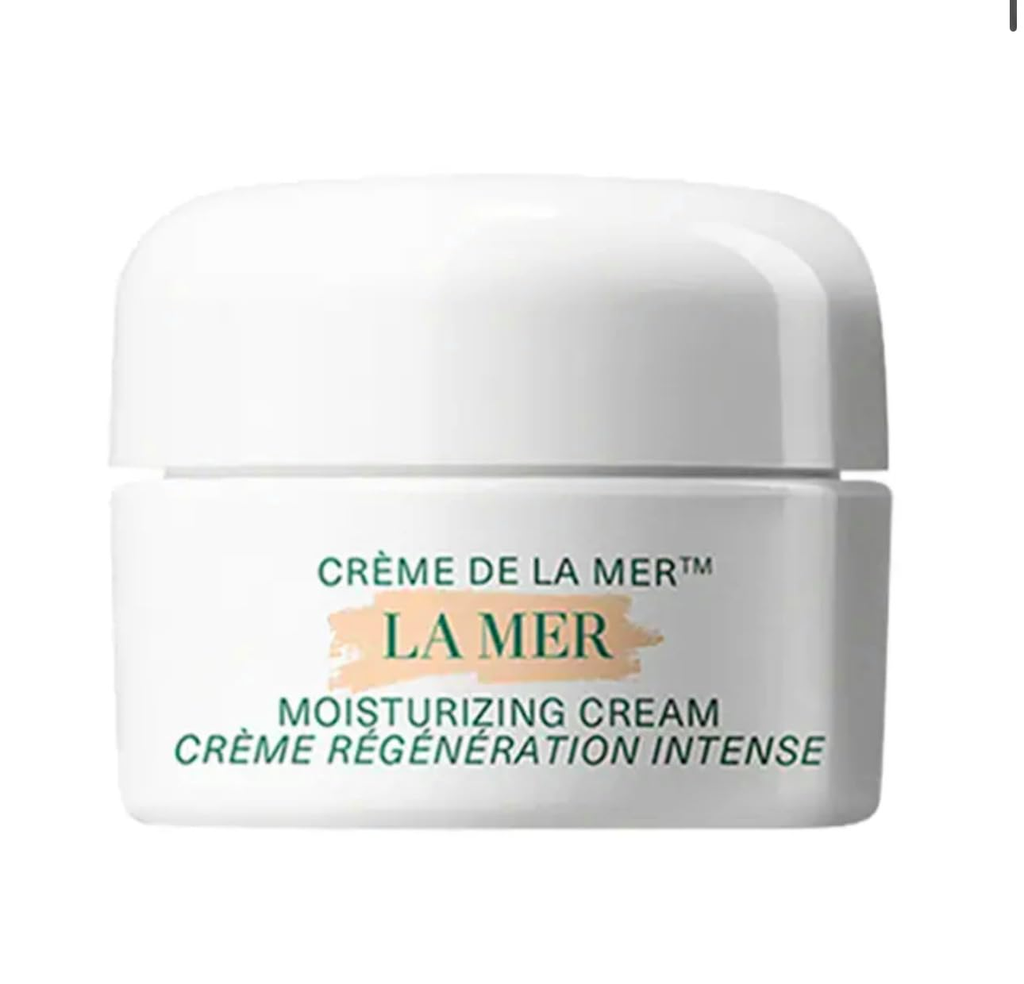
5. La Mer – Crème de la Mer
PROS:
- Rich, luxurious texture
- Excellent for very dry or compromised skin
- Strong barrier repair
- Iconic status in luxury skincare
CONS:
- No cellular-level action
- Minimal measurable wrinkle reduction
- Performance doesn’t match price
- Results are almost entirely surface-level
Lab Findings:
- Corneometer (hydration): +26.1% at week 12
- Cutometer (elasticity): R2 improved from 0.48 to 0.53 (+10.4%)
- Profilometry (wrinkle depth): -9.2% reduction
- Senescent cell markers: -3% (negligible)
- Measurement timeline: Week 4: 7.4%, Week 8: 8.9%, Week 12: 9.2%
La Mer is perhaps the most famous face cream in the world. Its origin story, a NASA scientist healing his burns with sea kelp, has been repeated so often it works like modern mythology. A single ounce costs roughly AU$300.
The Miracle Broth at the heart of the formula is a fermented blend of sea kelp, vitamins, minerals, and other marine ingredients. La Mer has never fully disclosed the broth’s composition, which adds to the mystique. What is known is that the fermentation process concentrates certain nutrients and creates bioavailable compounds that soothe and strengthen the skin barrier.
And as a barrier repair cream, La Mer is genuinely impressive. The moisture restoration is immediate and lasting. Dry, compromised, or reactive skin responds well to the rich, dense texture. Women who have dealt with environmental damage, medical treatments, or chronically dehydrated skin often report that La Mer provides relief where lighter formulas failed.
The hydration numbers in the lab confirmed this. At 26.1% improvement in moisture levels by week 12, La Mer posted the second highest hydration score in the entire ranking, behind only Cellexia. For pure moisture delivery, the formula works.
But moisture isn’t the same as anti-ageing. The wrinkle depth reduction of 9.2% is modest, and the measurement timeline shows that improvement was essentially complete by week 4. Between week 4 and week 12, wrinkle depth moved less than 2 percentage points. The cream reached its ceiling in one month and stayed there.
Senescent cell markers dropped just 3%, which is negligible. Nothing in the Miracle Broth is designed to address cellular ageing. The cream doesn’t target zombie cells. It doesn’t support telomere function. It doesn’t improve how fast or efficiently your skin cells divide.
There is a wider question here about price and value. La Mer costs roughly four to five times more than most products in this ranking. If that price reflected superior anti-ageing performance, it would be easy to justify. But the lab data shows a cream that hydrates exceptionally well while delivering below-average wrinkle reduction and no cellular benefit.
The price reflects the brand, the experience, and the mythology. It doesn’t reflect the measurable results. A woman paying AU$300 an ounce for La Mer is getting a superb moisturiser in luxurious packaging. She isn’t getting a product that changes how fast her face ages.
For very dry or barrier-compromised skin that needs deep moisture and soothing, La Mer remains a real option for those who can afford it. But as an anti-ageing treatment measured against the standard the AI study established, the formula doesn’t perform at its price level.
At this price, that gap is difficult to justify.
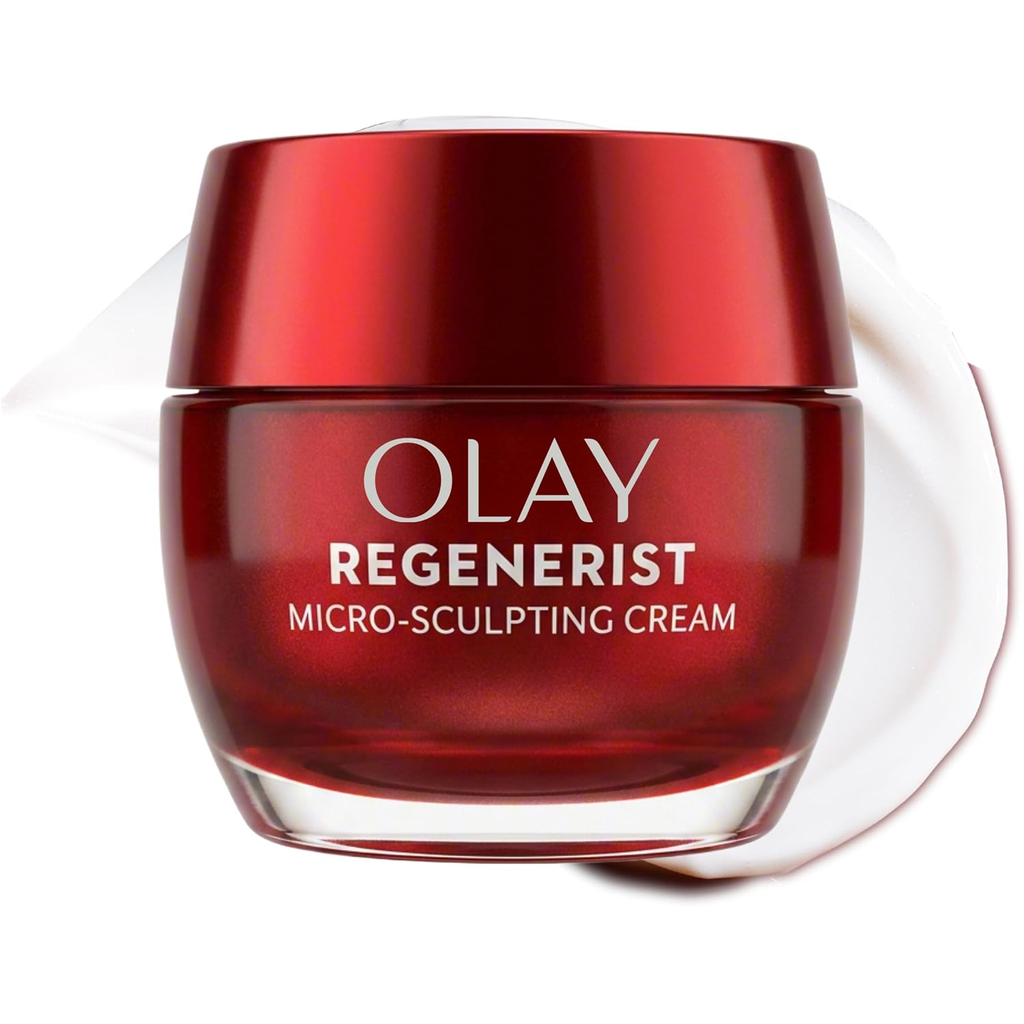
6. Olay – Regenerist Micro-Sculpting Cream
PROS:
- Excellent value for money
- Niacinamide and peptide combination
- Good texture and daily wearability
- Widely available
CONS:
- No cellular-level action
- Modest improvements overall
- Lower concentration than clinical formulas
- Results plateau quickly
Lab Findings:
- Corneometer (hydration): +20.3% at week 12
- Cutometer (elasticity): R2 improved from 0.49 to 0.54 (+10.2%)
- Profilometry (wrinkle depth): -10.4% reduction
- Senescent cell markers: -3% (negligible)
- Measurement timeline: Week 4: 7.8%, Week 8: 9.7%, Week 12: 10.4%
Olay Regenerist is the value champion. At roughly AU$45, it delivers more measurable improvement than creams costing five or six times as much. Niacinamide strengthens the barrier and evens tone. The amino-peptide complex provides mild structural support. Hyaluronic acid hydrates.
Niacinamide deserves special mention. It is one of the most thoroughly studied skincare ingredients in the world, with decades of clinical evidence showing it reduces redness, minimises pore appearance, strengthens the moisture barrier, and improves uneven skin tone. At the concentrations Olay uses, these effects are real and measurable.
The amino-peptide complex adds a layer of structural signaling. Peptides tell your skin to produce more collagen, and while the effect is mild at consumer-grade concentrations, it isn’t zero. Over weeks of consistent use, there is a genuine firming benefit that shows up in the elasticity measurements.
The texture is light, fast-absorbing, and compatible with makeup. It doesn’t feel clinical or heavy. For a cream that is meant to be used every morning without fuss, the user experience is well-designed. Olay has spent decades optimising this, and it shows.
The measurement timeline reflects the formula’s honest limits. At week 4, wrinkle depth dropped 7.8%. By week 8, 9.7%. By week 12, 10.4%. The improvement curve is gentle and flattening. Most of the gains happen early and then taper.
Senescent cell markers dropped 3%, which is negligible. The formula doesn’t contain any ingredients designed to target cellular senescence, support telomere function, or clear zombie cells. It wasn’t built for that purpose.
There is a useful comparison to make here. Olay’s wrinkle reduction of 10.4% isn’t dramatically different from La Mer’s 9.2%, yet it costs roughly a seventh of the price. On a pure results-per-dollar basis, Regenerist is arguably the most efficient product in this ranking. It does less than the top formulas, but it does far more per dollar than the luxury ones.
For a woman on a budget who wants a solid, science-backed daily cream that delivers real but modest improvements, Regenerist is a smart choice. It won’t change how fast your face ages at the cellular level. But if you are comparing it to other surface-and-structural creams, you can spend far more and get no better results.
The ceiling is clear. But for what it costs, the cream earns every dollar.
A smart purchase for what it is. But what it is has a clear ceiling.
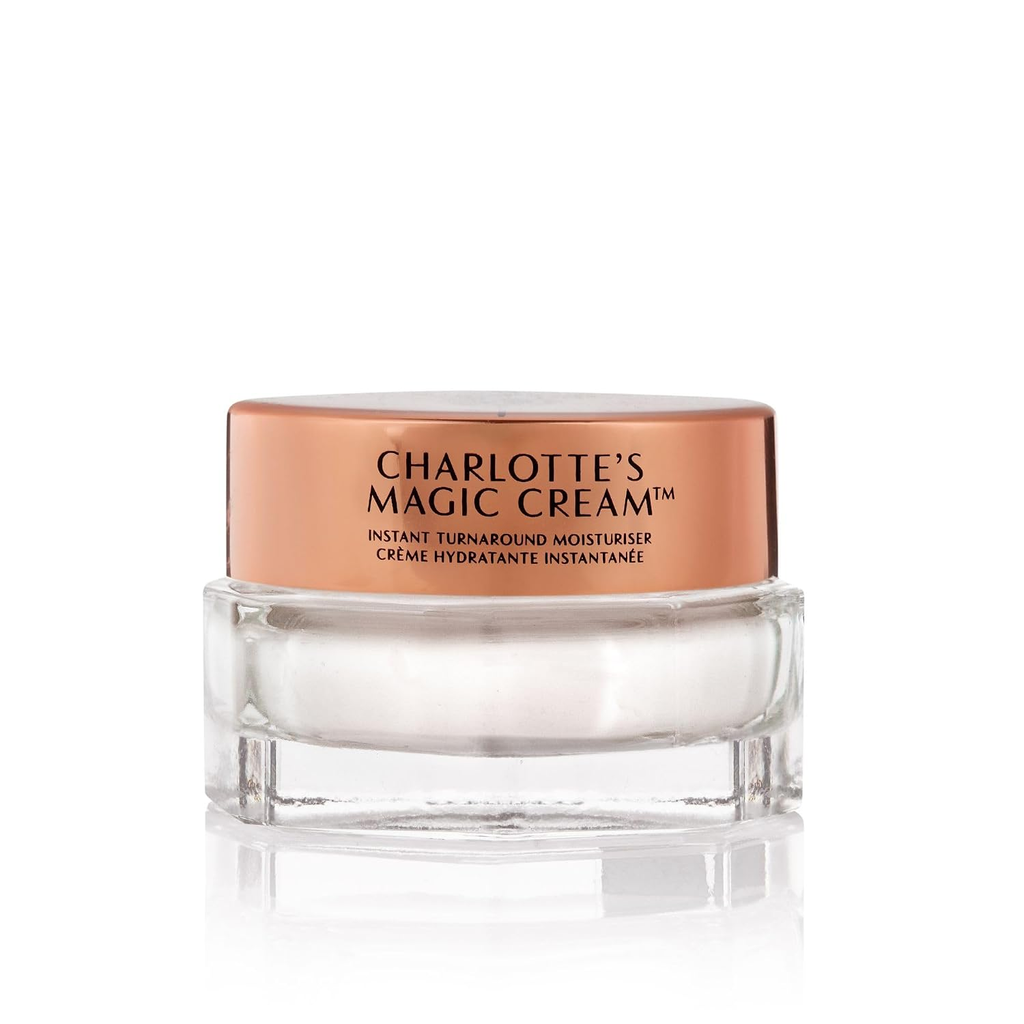
7. Charlotte Tilbury – Charlotte’s Magic Cream
PROS:
- Excellent as a makeup base
- Immediate smoothing and glow
- Pleasant texture
- Strong cosmetic payoff
CONS:
- Almost entirely cosmetic in effect
- No structural or cellular action
- Improvement is temporary, not cumulative
- Premium price for what is essentially a primer
Lab Findings:
- Corneometer (hydration): +18.4% at week 12
- Cutometer (elasticity): R2 improved from 0.47 to 0.51 (+8.5%)
- Profilometry (wrinkle depth): -7.6% reduction
- Senescent cell markers: -1% (no meaningful effect)
- Measurement timeline: Week 4: 6.2%, Week 8: 7.1%, Week 12: 7.6%
Charlotte Tilbury built Magic Cream on a single promise: your skin will look better the moment you apply it. That promise delivers. Light-diffusing particles smooth and blur. The texture creates a flawless canvas for makeup. Skin looks dewy and polished within minutes.
The formula uses a combination of rosehip oil, hyaluronic acid, vitamins C and E, and light-reflecting microspheres. The rosehip oil provides mild nourishment. The vitamins offer antioxidant protection. But the star of the show is the optical smoothing. The microspheres scatter light across the skin’s surface, softening the shadows that make lines look deep and pores look large.
The immediate cosmetic effect is genuinely impressive. In the test, participants looked visibly smoother within 15 minutes of application. Makeup sat better. Skin had a soft-focus quality that photographed well. For a woman preparing for an event, a video call, or a day where she wants to look polished, Magic Cream does its job.
But the lab data reveals what happens beneath that polished surface. Senescent cell markers dropped 1%, which is no meaningful effect at all. Wrinkle depth decreased just 7.6% over 12 weeks. The measurement timeline shows the pattern clearly: 6.2% at week 4, 7.1% at week 8, 7.6% at week 12. Nearly flat from the start.
What this means is that Magic Cream isn’t accumulating real structural or cellular improvement over time. The improvement it shows is almost entirely from the optical smoothing and mild hydration, not from any change in the skin itself. Wash the cream off and the improvement goes with it.
There is an important distinction here between a cream that makes your skin look better and a cream that makes your skin be better. Magic Cream does the first. It doesn’t do the second. The AI study measured how skin actually changed over a decade, and an optical smoother doesn’t register on that kind of measurement.
The price puts it in the mid-premium range. For a dedicated primer with skin-friendly ingredients, it isn’t unreasonable. But any woman buying Magic Cream as her primary anti-ageing treatment should understand that she is investing in daily cosmetic improvement, not in slowing down the ageing process.
Used alongside a treatment cream that works at a deeper level, Magic Cream adds a pleasant finishing layer. Used alone, it is a sophisticated way to look better today while the underlying ageing continues at its natural pace.
For a woman who already has her cellular and structural bases covered and wants something to make her skin glow on top, this is a fine choice. For a woman looking for one cream to slow down how fast her face ages, the data doesn’t support it.
This isn’t a treatment. It is a cosmetic. A very good one. It makes you look better today. It does nothing about how you will look in five years.
For a woman who already uses a treatment cream and wants a primer on top, Magic Cream is lovely. As a standalone anti-ageing product, the data doesn’t support it.
Top 7: Key Results At A Glance
For cellular-level renewal and continuous improvement: Cellexia Cellular Renewal Cream (Ranked #1). The only cream of 122 tested that produced a significant reduction in senescent cells (-44%). Wrinkle reduction still climbing at week 12 (31.2%). Frequently out of stock.
For anti-glycation science: SkinCeuticals A.G.E. Interrupter (Ranked #2). Strong structural formula with steady improvement through week 8. Wrinkle depth down 21.4%. Mild indirect effect on cellular markers.
For an everyday prestige cream: Estée Lauder Revitalizing Supreme+ (Ranked #3). Multi-peptide benefit with good daily wearability. Wrinkle depth down 16.8%. Plateaus at week 6. Minimal cellular effect.
For fast brightening: Sunday Riley Good Genes (Ranked #4). Exfoliation-driven improvement visible within days. Wrinkle depth down 13.1%. Nearly all gains in the first 4 weeks. Negligible cellular effect.
For luxury hydration: La Mer Crème de la Mer (Ranked #5). Excellent moisturiser and barrier repair. Wrinkle depth down 9.2%. No meaningful cellular action at a premium price.
For value: Olay Regenerist Micro-Sculpting Cream (Ranked #6). Best ratio of results to price. Wrinkle depth down 10.4%. No cellular reach.
For cosmetic smoothing: Charlotte Tilbury Magic Cream (Ranked #7). Excellent primer. Wrinkle depth down 7.6%. No meaningful cellular or long-term ageing effect.
What This Means For Your Skin
The AI study didn’t set out to sell anything. It set out to answer a question that has puzzled dermatologists for years: why do some women age so much faster than others, even when their habits, diets, and routines are similar?
The answer turned out to be simpler and deeper than anyone expected. It isn’t about what you put on your skin. It is about what is happening inside your cells. Women with fewer senescent cells age slower. Women with more of them age faster. That single variable predicted visible ageing more reliably than genetics, sun exposure, income, or how much a woman spent on skincare.
The Korean data confirmed it from a different angle. A genetic advantage in senescent cell clearance produced the same slowing effect, without any special products involved.
When the researchers then tested 122 face creams, the results lined up. Creams that reached the cellular level, the level where zombie cells accumulate and healthy cells stop dividing, produced results that kept improving past the point where everything else plateaued. Creams that worked only on the surface or the structural layer delivered real but limited benefits that stopped building after a few weeks.
None of this means surface-level skincare is worthless. Hydration matters. Sun protection matters. A good moisturiser is better than no moisturiser. But if the goal is to change the trajectory, to actually slow down how fast your face ages rather than temporarily covering up the signs, the data points in one direction.
The products that addressed cellular senescence delivered longer-lasting, deeper, and more progressive results than everything else in the test. That was true whether the measurement was wrinkle depth, elasticity, firmness, or the rate of continued improvement past week eight.
Your skin ages at its own speed. That speed isn’t fixed. And for the first time, the science can measure what controls it.
Sources
4. Farage M.A. et al., “Characteristics of the ageing skin,” Advances in Wound Care, 2013;2(1):5-10.
5. Tobin D.J., “Introduction to skin ageing,” Journal of Tissue Viability, 2017;26(1):37-46.
Professor Charlotte Weber, MD is a board-certified dermatologist with 25 years specialising in ageing skin. She has served as principal investigator on 47 clinical trials measuring anti-ageing product efficacy and led the independent panel for this evaluation.
Marcus Bauer, PhD is a cosmetic formulator and dermatological research scientist with 26 years of professional experience. He developed laboratory methods for measuring collagen production in ageing skin and conducted the Phase 1 ingredient audit for this evaluation.
Laura Schmidt, MD, FRCP is a consultant dermatologist with a specialist practice in non-invasive skin rejuvenation. She has performed over 15,000 anti-ageing treatments and supervised the clinical trial across multiple Australian testing sites.